Can one be an ally if they are unable to walk in the other’s shoes? Are artists only entitled to produce work that springs from their own direct experience?
Taylor Renee Aldridge, a Detroit based writer and independent curator who co-founded ARTS.BLACK, a journal of art criticism from Black perspectives, claims that social practice in art has risen in status in recent years.[1] She claims that as a result of the rise of influence of political movements, such as Black Lives Matter, there has been an increase in work focused on issues such as racism, homophobia. The popularity of contemporary art work focusing on these issues has brought them into mainstream art, making them seem appealing and timely, yet we have to exercise caution in the changing times of sensitivity and awareness not to make a spectacle of the issues, rather than making a call for social change.
The work of New Orleans artist Ti-Rock Moore, a middle-aged, white Lesbian, has brought this question to the forefront of many viewers and critics’ minds. Her controversial exhibit “Confronting Truths: Wake up!” sparked outrage in the black community. Moore featured a life-size realistic sculpture of Michael Brown, the 18 year-old fatally shot by police, in the moments after his death, face down on the sidewalk, surrounded by police tape.

Moore was accused of profiting from her white privilege, and admittedly referred to herself as possibly a “big, fat, bleeding-heart liberal with massive guilt” and as never having experienced racism, and of having experienced “white privilege 100 percent of the time” in a well-known interview with writer Rosemary Reyes, entitled “Not Black and White” [2]
If empathy truly is “at the heart of allyship”, as suggested by Ng et Al[3], then Moore, according to her own artist’s statements and position, is an ally of the Black Lives Matter movement and the black community. However, what constitutes allyship?
Moore argues that her work originates from an awareness of her own white privilege and her anger at a system that perpetuates mindless hatred and racism in America. However, when questioned about profiting from the subject she is ironically hoping to defend, (black bodies, damaged by this very system), her response only serves to perpetuate her own position of white privilege when she replies: “My art is expensive to make. I am very far in the hole, and it has gotten to the point that I must start making money to be able to make more art.” This is perhaps the comment that indicates Moore’s true intentions to many, and that has angered so many members of the black community, exacerbated by the fact that Michael Brown’s own father went on the record calling the exhibit: “disgusting”.
Many other examples of such sensationalistic work exist in the contemporary art scene and have caused equal controversy. One such work is Dana Schutz’s semi-abstract painting of Emmett Till that generated so much protest at the 2017 Whitney Biennial that a campaign was launched for its removal and destruction. [4] Although Schultz claimed that empathy for the mother of Emmett Till was the motivation for her work, the debate it caused has been credited with splitting the art world into two. While Schultz claims that: “Art can be a space for empathy, a vehicle for connection. I don’t believe that people can ever really know what it is like to be someone else (I will never know the fear that black parents may have) but neither are we all completely unknowable.” [5]
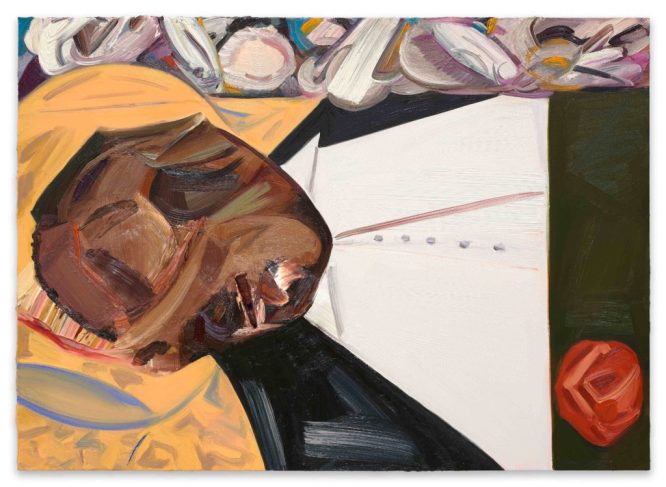
“It’s not acceptable for a white person to transmute Black suffering into profit and fun,” says artist Hannah Black.
Clearly, galleries, artists and educators have to do the hard work of examining allyship and their/our role in “being institutions not only of social value but in being institutions of social justice. Diversity work is complex and heterogeneuous”[6]
Perhaps that is why the issue of allyship is still not as simple as black or white.
[1] http://www.artnews.com/2016/07/11/black-bodies-white-cubes-the-problem-with-contemporary-arts-appropriation-of-race/
[2] http://pelicanbomb.com/art-review/2015/not-black-and-white-ti-rock-moore
[3] Wendy Ng, Syrus Marcus Ware & Alyssa Greenberg (2017) Activating Diversity and Inclusion: A Blueprint for Museum Educators as Allies and Change Makers, Journal of Museum Education, pg. 144
[4] https://news.artnet.com/art-world/dana-schutz-painting-emmett-till-whitney-biennial-protest-897929
[5] https://www.textezurkunst.de/articles/baker-pachyderm/
[6] Wendy Ng, Syrus Marcus Ware & Alyssa Greenberg (2017) Activating Diversity and Inclusion: A Blueprint for Museum Educators as Allies and Change Makers, Journal of Museum Education, 42:2, 142-154, p 143

 Can Art Teach